
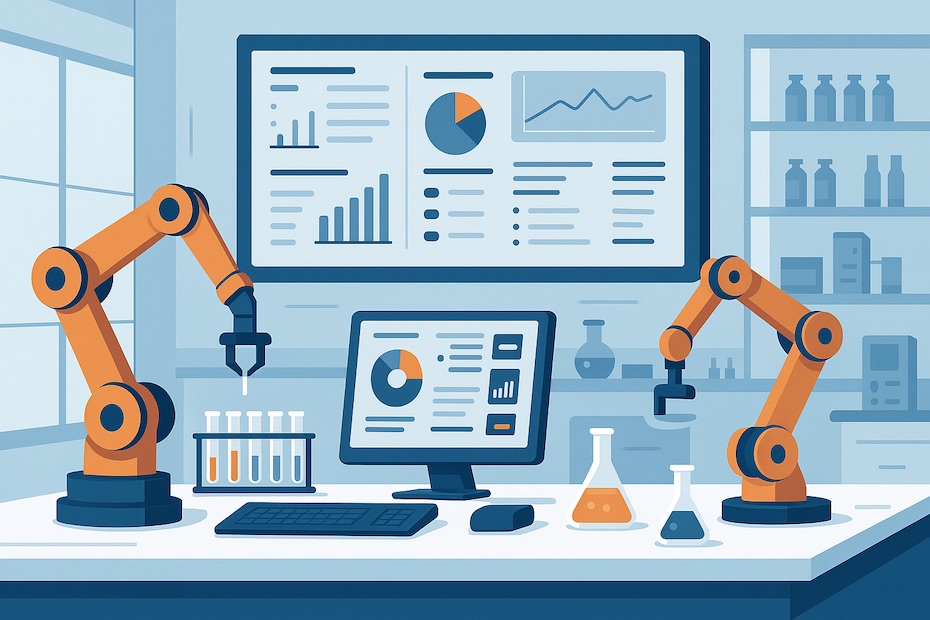
Modern R&D labs that integrate automation achieve measurable gains in accuracy, throughput, and reproducibility. You strengthen your research capacity by deploying the right automation tools that optimize both time and data precision.
This article outlines five essential lab automation tools that have reshaped research productivity across industries. You’ll learn how each tool functions, where it fits best, and how you can integrate it to accelerate innovation without sacrificing scientific integrity.
1. Automated Liquid-Handling Systems
Automated liquid-handling systems form the foundation of modern lab automation. They eliminate repetitive manual pipetting, reduce variability, and improve accuracy across hundreds of daily assays.
You use these systems to automate sample preparation, reagent dispensing, and plate handling. Their programmable workflows enable consistent liquid transfers that minimize technician fatigue and human error. In high-throughput labs, they also support 24/7 operations, allowing you to schedule experiments outside regular working hours.
Data from McKinsey & Company shows that labs using automated liquid handling can cut experiment setup time by up to 60%, leading to shorter project cycles and higher reproducibility. Companies such as Hamilton Robotics, Tecan, and Beckman Coulter dominate this segment by offering scalable platforms adaptable to both biology and chemistry workflows.
The added benefit is flexibility: modern systems integrate with LIMS and ELNs, automatically updating experiment data to your digital workflow. When precision, repeatability, and speed are non-negotiable, this is the first automation investment you make.
2. Laboratory Information Management Systems (LIMS)
A Laboratory Information Management System acts as the digital backbone of your R&D operation. It connects instruments, tracks samples, manages workflows, and organizes experimental metadata in real time.
Without LIMS, you rely on spreadsheets and paper notes that slow down data retrieval and risk version confusion. By implementing a robust LIMS, you centralize data flow and eliminate manual record-keeping errors. Cloud-based systems like Thermo Fisher’s SampleManager LIMS or LabWare LIMS allow multiple users to collaborate, audit, and analyze data simultaneously from any location.
You also improve compliance and traceability — two critical needs in regulated industries such as pharmaceuticals and biotech. Each step of an experiment is timestamped and stored, ensuring accountability.
Key benefits you gain with LIMS integration:
- Unified data storage with secure user access.
- Automated sample tracking across workflows.
- Built-in analytics dashboards for KPI visualization.
- Streamlined instrument integration for seamless communication.
By connecting your LIMS with automated hardware and ELNs, you transform your lab from a reactive operation into a data-driven research engine capable of scaling efficiently.
3. Integrated Robotic Platforms for Synthesis and Screening
Integrated robotic platforms combine multiple stages of the R&D workflow — synthesis, analysis, and screening — into one synchronized unit. You use these platforms to automate complex, multi-step experiments that would otherwise take days of manual effort.
A single robotic arm can load, incubate, sample, and analyze materials while communicating results directly to your LIMS or data analysis software. The result is a continuous feedback loop that supports high-throughput discovery and optimization.
Companies like Bruker and PerkinElmer have developed modular robotic platforms that handle compound synthesis, chromatographic separation, and spectral analysis. These systems accelerate discovery cycles in pharmaceuticals, materials science, and chemical engineering.
By implementing integrated robotics, you reduce cross-departmental bottlenecks, minimize sample transfer errors, and achieve near-continuous operation. Your scientists shift from mechanical execution to strategic design — focusing on hypotheses and results interpretation rather than repetitive execution.
4. Data Orchestration and Analytics Platforms
Automation delivers its full potential only when backed by data orchestration and analytics software. You deploy these platforms to coordinate instruments, schedule workflows, and monitor system performance in real time.
Modern orchestration tools such as Benchling, Dotmatics, or LabVantage enable you to visualize the entire R&D pipeline from experiment planning to output validation. They aggregate data from diverse instruments, detect process bottlenecks, and generate actionable insights for decision-making.
A connected analytics platform helps you measure instrument utilization, experiment throughput, and reagent consumption — critical KPIs for maintaining lab efficiency. According to McKinsey’s 2024 Life Sciences report, data orchestration combined with automation can reduce operational downtime by up to 40%, significantly improving output capacity.
When you leverage these insights, you not only boost R&D efficiency but also create a foundation for predictive modeling, enabling you to anticipate issues before they disrupt your workflow.
5. Electronic Lab Notebooks (ELNs) and Cloud-Based Collaboration Tools
Electronic Lab Notebooks (ELNs) serve as your digital record of experimentation — replacing handwritten notes with cloud-based platforms that integrate seamlessly with LIMS, analytics tools, and automation hardware.
You can schedule experiments, store protocols, attach data files, and share real-time updates with collaborators. ELNs such as LabArchives and Benchling allow you to maintain consistent documentation across multi-site research teams.
Cloud-based ELNs improve accessibility: your team can monitor experiment progress, analyze data, and manage protocols from any location. This capability proved especially valuable as research increasingly adopts remote and hybrid models.
Beyond convenience, ELNs strengthen intellectual property protection. Timestamped and immutable records ensure that experiment ownership is verifiable. You no longer worry about missing notebooks or ambiguous handwriting — every change is traceable and auditable.
Integrating These Tools for Peak R&D Performance
Deploying these five tools in isolation is not enough; integration is where the performance gains truly compound. You align your automation systems through an orchestration layer that ensures all instruments communicate seamlessly.
You begin by mapping your workflow — from sample receipt to result generation — to identify manual choke points. Once automation is deployed in key areas such as sample prep or data logging, you measure results, standardize best practices, and scale across other workflows.
Practical implementation roadmap:
- Identify the process with the highest manual repetition.
- Define success metrics: time savings, reproducibility, or cost per run.
- Select tools with open APIs and modular compatibility.
- Pilot the automation in one workflow, gather performance data.
- Expand integration to other departments once ROI is validated.
Labs that follow this iterative implementation model consistently outperform peers in experiment throughput and data quality.
Common Pitfalls to Avoid When Automating R&D
Automation is powerful, but poor deployment can derail even well-intentioned programs. The most common mistake is installing rigid, production-grade systems in dynamic research settings. R&D requires flexibility — protocols change, reagents vary, and methods evolve constantly.
When you select systems that cannot adapt to workflow adjustments, you end up with idle robots and frustrated scientists. Avoid this by prioritizing modular designs and customizable software interfaces.
Another frequent misstep is neglecting training. A well-implemented system becomes underused when staff lack the technical fluency to operate or troubleshoot it. Continuous upskilling is part of your long-term automation strategy.
You also must prevent data fragmentation. If your instruments, ELNs, and LIMS do not share a unified data architecture, you risk creating isolated silos that reduce traceability. Integration remains the key to realizing your investment’s full value.
How to Measure the ROI of Lab Automation
You quantify success using clear operational metrics. Measure experiment cycle time, instrument uptime, error rates, and overall cost per result. Comparing pre- and post-automation data reveals where your investment delivers measurable gains.
According to Pharma IQ’s Automation Benchmark Report (2024), laboratories that track these indicators report an average 25–35% reduction in project timelines and up to 50% fewer manual errors.
You should visualize results through dashboards that provide instant feedback on throughput, reagent use, and performance trends. When paired with AI-driven analytics, your system can recommend workflow optimizations automatically.
Tracking tangible metrics turns automation from a cost center into a competitive advantage.
The Future of Lab Automation: AI and Autonomous Research
The next frontier of lab automation merges robotics with artificial intelligence. You’re beginning to see “self-driving laboratories” capable of designing and executing experiments autonomously.
AI models analyze experimental outcomes in real time and adjust parameters on the fly, creating a closed feedback loop between hypothesis, execution, and validation. This model is gaining adoption in materials science, genomics, and drug discovery.
However, this shift also requires rethinking infrastructure — your future lab must support constant data flow, machine learning pipelines, and advanced robotics capable of multi-step decision-making.
Industry analysts predict that by 2030, over 70% of new R&D facilities will include AI-augmented automation as a core operational feature. To stay ahead, you must continuously evaluate your systems and upgrade where data and performance intersect.
Top automation tools improving R&D efficiency
- Automated liquid-handling systems reduce error and increase throughput.
- LIMS centralizes data and integrates instruments.
- Robotics, analytics, and ELNs streamline workflows for higher output.
Building the High-Performance Lab of the Future
Your R&D efficiency depends on how strategically you deploy automation. By combining liquid-handling systems, LIMS, integrated robotics, orchestration software, and ELNs, you create a lab that operates with the precision and agility of a high-performing enterprise. The more synchronized your data and processes become, the more your scientists focus on discovery, not documentation. Treat automation as a continuous training regimen — refine, measure, and scale relentlessly.

Maurizio Chiriva Internati (DBSc, PhDs) is a cancer immunologist and biotech entrepreneur with 20+ years in immuno-oncology. Co-founder and former CEO of Kiromic BioPharma (NASDAQ: KRBP), he has led AI-driven target discovery and translational programs, and has served on faculty at MD Anderson and Texas Tech.