
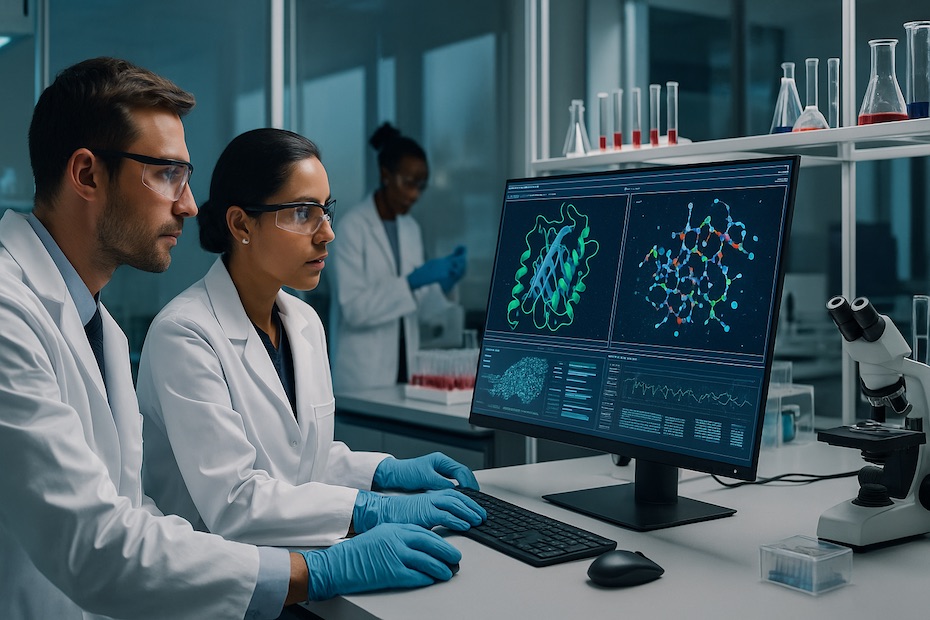
Artificial intelligence is no longer a buzzword in biotech—it’s the engine driving faster, cheaper, and more accurate drug discovery. The most advanced AI tools now help you predict protein structures, identify novel compounds, and optimize preclinical testing with unmatched precision.
In this article, you’ll explore seven powerful AI tools that are reshaping drug discovery and biotech R&D. You’ll understand how each platform accelerates discovery timelines, reduces failure rates, and enhances innovation capacity within your lab or organization.
Tool 1: AlphaFold – Revolutionizing Protein Structure Prediction
AlphaFold by DeepMind changed the scientific playbook when it solved the 50-year protein-folding problem. You use it to predict 3D structures of proteins from amino acid sequences, which saves months of wet-lab experimentation.
AlphaFold has mapped more than 200 million proteins, empowering researchers to visualize targets that were once unsolvable. By integrating these structural predictions into your drug discovery pipeline, you shorten the gap between target identification and candidate optimization.
Pharmaceutical giants like Pfizer and Novartis have adopted AlphaFold’s predictions to model protein-ligand interactions faster, leading to more informed molecular design. Its open database now supports academic, biotech, and pharmaceutical research worldwide—making it one of the most democratizing innovations in the field.
Tool 2: AtomNet (Atomwise) – Accelerating Small Molecule Screening
Atomwise’s AtomNet applies deep convolutional neural networks to predict molecular binding affinities. This allows you to screen billions of compounds in days rather than months.
Its model learns from millions of protein-ligand structures, uncovering hidden chemical relationships that traditional docking methods might overlook. This accelerates lead identification, enabling more targeted experiments and fewer wasted resources.
Atomwise has partnered with over 750 research institutions and biotech firms to advance small-molecule programs. Its success in repurposing drugs for diseases like Ebola and multiple sclerosis demonstrates the platform’s power in translating data into real therapeutic breakthroughs.
Common applications for AtomNet users include:
- Virtual high-throughput screening for binding affinity prediction
- Hit optimization using 3D structural learning
- Repurposing pipelines for rare or neglected diseases
- Predictive toxicity and selectivity analysis
Tool 3: Insilico Medicine’s Chemistry42 and PandaOmics – Generative AI for End-to-End Discovery
Insilico Medicine has established itself as a front-runner in generative AI for pharmaceutical R&D. Its two flagship platforms, Chemistry42 and PandaOmics, cover both drug generation and target discovery.
Chemistry42 uses reinforcement learning and generative adversarial networks to design novel molecules with optimal properties. PandaOmics, on the other hand, uses omics data and NLP models to identify disease targets and biomarkers. Together, they provide a full-stack AI ecosystem—from idea to IND filing.
Insilico’s AI-designed fibrosis drug entered Phase I trials in record time—18 months from concept to clinic—showing how you can leverage AI to bypass lengthy discovery cycles. Their results have inspired partnerships with companies like Fosun Pharma and EQRx.
Tool 4: Schrödinger – Physics-Based AI for Molecular Simulation
Schrödinger’s platform merges physics-driven simulation with AI-driven predictive modeling, giving you unparalleled control over molecular behavior.
The company’s flagship tool, Schrödinger Suite, combines molecular dynamics, docking, and free-energy calculations to guide compound selection and optimization. When integrated with its deep learning engine, it produces highly accurate predictions of binding energies and solubility.
Many top pharma companies use Schrödinger to reduce the number of synthesis cycles required per drug candidate. In one reported collaboration, Schrödinger’s simulations helped save 12–18 months of R&D time and significantly cut preclinical costs.
Tool 5: Iktos – Generative AI for De Novo Molecular Design
Iktos applies deep generative models to automate de novo drug design, helping you create novel, synthetically accessible molecules that meet specific target profiles.
Its platform combines generative chemistry, retrosynthesis prediction, and automated compound synthesis planning. By training on large chemical databases, Iktos enables rapid ideation of candidate molecules with desirable pharmacokinetic and toxicity profiles.
The company has collaborated with firms like Merck KGaA, Janssen, and Almirall, proving its utility in early-stage discovery. The speed and cost efficiency make Iktos a valuable addition to any biotech pipeline focused on innovation-driven growth.
Tool 6: Exscientia – Precision AI for Patient-Centric Drug Design
Exscientia integrates AI with translational biology to design precision medicines tailored to individual patient profiles. Its platform blends molecular design, target validation, and patient-derived data to ensure that the drugs you develop are not only effective but also clinically relevant.
The company’s AI-designed compound for obsessive-compulsive disorder was the first fully AI-generated molecule to enter human trials. Exscientia’s end-to-end automation—from target to trial—reduces uncertainty in R&D decisions, improving success rates in clinical transitions.
The platform’s modular nature also allows your team to scale experiments efficiently, leveraging real-world patient data for faster feedback loops.
Tool 7: BenevolentAI – Integrating Knowledge Graphs for Novel Discovery
BenevolentAI uses deep learning and knowledge graph technology to connect data from scientific papers, patents, trials, and omics datasets. This enables you to uncover hidden therapeutic relationships and predict novel drug-disease associations.
The company gained attention when its AI identified baricitinib as a potential therapeutic candidate for immune regulation. Its success validated how machine learning can generate new hypotheses and reposition drugs faster than traditional methods.
BenevolentAI’s platform integrates seamlessly with existing informatics infrastructures, allowing teams to visualize molecular interactions and prioritize candidates with strong mechanistic rationale. This makes it ideal for biotech organizations focusing on hypothesis generation and early discovery.
How to Choose the Right AI Tool for Your Biotech R&D
Selecting the best AI platform depends on your research stage, data quality, and computational resources. Each tool has distinct strengths—some excel in structure prediction, others in small molecule generation or target identification.
Before committing to an AI partner, evaluate:
- Integration: How well the tool fits within your existing data systems and workflows.
- Transparency: Availability of interpretable outputs and validation datasets.
- Scalability: Ability to handle large datasets or multi-target projects efficiently.
- Partnership potential: Proven track record in industry collaborations and regulatory support.
Choosing the right AI partner is not only about technology but also about support, interpretability, and scientific collaboration. The goal is to enhance your decision-making speed while maintaining experimental reliability.
Common Limitations and Adoption Pitfalls
AI in drug discovery is powerful, but it’s not infallible. Limited data diversity, biased datasets, and interpretability issues can produce misleading results if left unchecked.
To mitigate these risks, you must maintain strong human oversight and cross-validation processes. AI should complement—not replace—your expertise. Regulatory considerations around data provenance and algorithm transparency also require strategic foresight.
The most successful organizations use hybrid models: human-guided hypothesis generation paired with AI-driven analytics. This synergy ensures that innovation remains rigorous and scientifically grounded.
Key Facts on AI in Drug Discovery
- AI reduces drug discovery timelines by up to 70%.
- Over 300 biotech companies now integrate AI-driven R&D tools.
- The AI in drug discovery market is projected to reach US $9.1 billion by 2030.
Innovate Faster, Validate Smarter
AI is no longer an experimental tool—it’s your competitive edge in modern biotechnology. By adopting platforms like AlphaFold, AtomNet, and Insilico Medicine, you position your team to accelerate innovation, validate findings faster, and control costs effectively. The organizations that master these tools today will lead the next generation of precision medicine tomorrow.

Maurizio Chiriva Internati (DBSc, PhDs) is a cancer immunologist and biotech entrepreneur with 20+ years in immuno-oncology. Co-founder and former CEO of Kiromic BioPharma (NASDAQ: KRBP), he has led AI-driven target discovery and translational programs, and has served on faculty at MD Anderson and Texas Tech.