
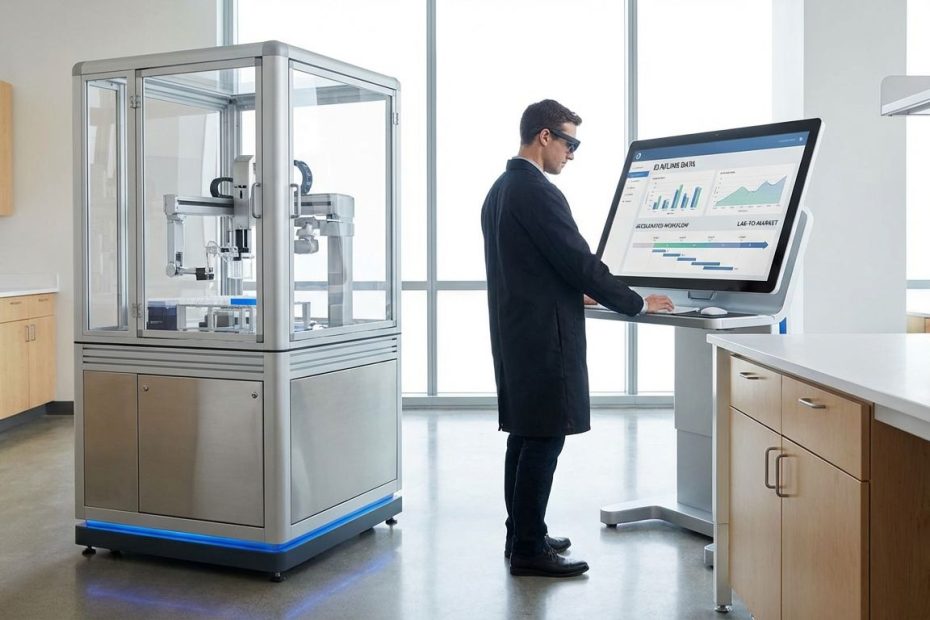
You accelerate biotech innovation when five capabilities run as one system: structured lab data, automated execution, AI-guided prioritization, FAIR-ready interoperability, and compliance-grade record controls. When those pieces connect, you cut rework, shorten handoffs, and keep decisions defensible from discovery through tech transfer.
This article breaks down five tool categories that consistently compress timelines in real organizations, plus the selection rules that keep teams out of integration debt. You will get practical guidance on what to implement first, what to standardize, what to measure, and how to keep speed without creating a future validation crisis.
Tool 1: ELN And LIMS Platforms That Turn Experiments Into Shippable Knowledge
If you want “lab-to-market” speed, start by treating ELN and LIMS as the operating system of your R&D execution, not a notebook replacement. Your goal is to ensure every result is linked to the inputs, versions, protocols, and approvals that produced it. That linkage is what prevents the slowest tax in biotech, the “rebuild the story from scratch” scramble when a program moves from discovery to development, or when a partner asks for lineage you cannot produce quickly.
Modern lab informatics platforms also fix the daily friction that quietly bleeds time: copy-paste metadata, mismatched sample IDs, and experimental context buried in free text. A mature ELN/LIMS setup enforces templates, controlled fields, sample registry rules, and consistent naming, so downstream analytics stops being a custom project for every dataset. That consistency matters more than any single dashboard, since it determines whether your data is searchable, comparable across runs, and reusable during scale-up.
Market demand keeps rising for unified lab platforms because they support cloud access, automation integration, and AI-assisted workflows, all of which reduce manual handling and increase throughput. In practice, teams buy ELN/LIMS because they want fewer failures in tech transfer, fewer “lost days” looking for the right run context, and fewer QA surprises when regulated work begins. When the platform is implemented well, it becomes the shared language across biology, chemistry, analytics, and process development, which is the real accelerator.
One direction worth paying attention to is ELN/LIMS vendors embedding AI directly into daily work so scientists stop jumping between disconnected tools. Benchling publicly positioned Benchling AI as a workflow-embedded command center with agents and models intended to speed analysis, reporting, and retrieval without moving data out of governed systems, and it also highlighted deeper automation integrations and in-platform scripting to automate transformations. That is the correct product direction because it turns ELN/LIMS from “where data goes to rest” into “where decisions get made.”
Tool 2: No-Code Liquid Handling That Converts Bottlenecks Into Throughput
Automation pays off when it removes the most failure-prone minutes of a workflow: pipetting variability, timing drift between steps, and inconsistent mixing, incubation, or transfers across operators. Liquid handling robotics can compress cycle time by enabling parallelization and longer unattended runs, but the bigger win is consistency. Reproducibility is a speed feature because it reduces reruns, reduces argument about what happened, and increases confidence in what to scale.
The adoption barrier used to be software complexity and the need for an automation engineer to keep scripts alive. That barrier keeps dropping because vendors are shipping no-code interfaces that let bench scientists execute common tasks reliably with minimal setup time. Opentrons, for example, introduced Flex Prep as a touchscreen-driven, no-code system aimed at quick task setup for routine pipetting operations like plate prep, dilutions, and reformatting, with a clear push toward “walk-up” usability. When usability is high, automation stops being a special project and becomes daily infrastructure.
To make automation accelerate “lab to market,” connect it to your data system so every run produces structured context automatically. That means the worklist, deck layout, labware identifiers, calibration versions, operator, timestamps, and environmental conditions land in your ELN/LIMS without manual transcription. If your automation produces files that live in a shared drive and get attached to notebooks later, you still improved pipetting, but you did not fix traceability. Traceability is what makes results portable across teams and sites.
Industry programs are also reinforcing that “connected lab” model where robotics, orchestration, and lab data platforms operate as one environment rather than isolated islands. At Bio-IT World Expo’s AI-driven lab automation programming, the emphasis is on interoperable ecosystems, data lineage, harmonized workflows, orchestration engines, and architectures that scale beyond pilots. That focus mirrors what works in production settings: modular automation tied to clean data pipelines, not one-off demos.
Tool 3: AI Drug Discovery That Reduces Wet-Lab Load Through Better Prioritization
AI in drug discovery creates value when it changes what your team runs in the lab tomorrow morning. The practical win is prioritization: fewer low-value experiments, faster narrowing of chemical or biologics search space, and tighter feedback between design and test. The moment AI outputs become “interesting slides” instead of inputs to execution, timelines stop improving.
At the platform level, the most productive categories remain structure-informed modeling, virtual screening, and design or optimization engines. These tools can reduce the number of cycles needed to reach a lead series by selecting compounds with higher expected value. Teams that benefit most already have disciplined assay data capture and can measure whether AI improves hit rate, reduces cost per validated hit, or shortens the design-make-test-analyze loop.
Public signals also show ongoing investment in this approach. Reporting on Isomorphic Labs described a major funding round aimed at expanding an AI drug design engine, growing the team, and pushing AI-designed programs toward clinical development, alongside partnerships with large pharma organizations. That matters because it reflects a strategic bet: building AI systems that connect to real development paths, not only early discovery proofs.
It is also important to keep your expectations operational. Serious coverage has also highlighted that AI drug discovery is constrained by biology and by data quality, and that fast claims do not automatically translate into approvals. That does not reduce the value of AI, it sharpens the requirement that your lab data, assay definitions, and experimental metadata must be clean enough for models to learn and for teams to trust decisions. AI speed arrives when data hygiene becomes non-negotiable.
Tool 4: Deep-Learning Virtual Screening That Competes On Enrichment And Speed
Virtual screening becomes an accelerator when it produces enriched candidate lists fast enough that wet-lab validation turns into a steady pipeline, not sporadic bursts. The two metrics that matter most are enrichment performance, how many actives show up early in the ranked list, and throughput, how quickly large libraries can be screened. If either metric fails, screening becomes expensive noise.
Recent research platforms have been explicit about targeting both enrichment and speed. The HelixVS preprint described a multi-stage structure-based virtual screening pipeline enhanced by deep learning, reporting higher enrichment than classic docking baselines and significantly faster screening speeds. It also reported wet-lab validation across multiple pipelines with a meaningful fraction of tested molecules showing activity at micromolar or even nanomolar levels. Those claims represent the exact direction teams want: screen more, test less, and test smarter.
Operationally, this category succeeds when it is connected to the same systems that store assay outcomes and compound identifiers. Screening tools that output a ranked CSV without integration quickly create mismatches between what was predicted, what was tested, and what is now registered in your compound or biologics registry. Link predictions to IDs, versions, and assay context, then track performance over time. That loop converts virtual screening from a one-time effort into a compounding asset.
Use a scorecard to decide whether deep-learning screening belongs in your stack: time to generate ranked lists, enrichment in the top tranche, reproducibility across targets, compute cost per million compounds, and ease of connecting outputs into your registry and ELN. If those are not measurable, the tool will not change execution, and it will not accelerate timelines.
Tool 5: FAIR Data Practices That Make Every Other Tool Faster
FAIR is not a single product you buy, it is the set of engineering rules that determines whether your data can move through tools and teams without translation work. FAIR stands for Findable, Accessible, Interoperable, and Reusable, and it matters because biotech productization depends on reusing results across studies, sites, and phases of development. If you cannot find the data fast, interpret it consistently, and reuse it with confidence, your program slows down when it matters most.
The original FAIR principles emphasized machine-actionability, meaning data and metadata should be structured so computational systems can find and use them with minimal human intervention. That requirement maps directly to today’s reality where AI agents, analytics pipelines, and automation systems need consistent identifiers and metadata to function reliably. If a scientist has to “explain the dataset” every time it is touched, scale becomes expensive and slow. Design patterns emerging from peer-reviewed research on FAIR biomedical data systems demonstrate how standardized metadata schemas and persistent identifiers enable reproducible AI workflows and cross-study interoperability.
FAIR practices show up as controlled vocabularies, consistent assay templates, mandatory metadata fields, persistent identifiers for samples and batches, and standard exchange formats. FAIR-aligned design also reduces integration cost because APIs and connectors can rely on predictable structures rather than one-off parsing. This is where many organizations win back months: fewer custom ETL projects, fewer broken joins across systems, and less time spent debating which dataset is authoritative.
FAIR also supports transfer readiness. When process development inherits discovery data, or when a partner performs diligence, FAIR-aligned records reduce ambiguity and accelerate reviews. You can still move fast with messy data for a while, but you cannot move fast into scale-up and partnerships without standardization.
Tool 6: Part 11-Aligned Electronic Records And E-Signatures That Prevent Late-Stage Delays
Regulated reality arrives earlier than most teams expect. Even in preclinical work, you will start making decisions that later need defensible records, and you will also start using systems that create data used in regulated narratives. The goal is not to drown R&D in bureaucracy, it is to prevent a late-stage pause where QA forces re-validation, re-documentation, or re-testing because records lack integrity controls.
The FDA’s Part 11 guidance explains when electronic records and electronic signatures fall under Part 11 and describes a narrow interpretation of scope tied to whether electronic records are used in place of paper records under predicate rules. It also describes enforcement discretion for certain requirements in specific circumstances, while still emphasizing that predicate rule requirements and key controls remain enforceable. Teams that move quickly still need access controls, accountability for e-signatures, appropriate system checks, and documentation controls, since those are the pieces inspectors and auditors scrutinize first.
Practically, Part 11 alignment in a “lab-to-market” toolchain means your ELN/LIMS, instrument data systems, and automation logs must preserve integrity: audit trails where needed, secure time-stamps, controlled access, and clear policies for who signs what and why. Keep electronic signatures purposeful, tied to meaningful state changes like review, approval, and release to the next stage. When signatures become ceremonial, people route around them and you lose the benefit.
Make validation and change control part of normal operations. If your lab tools update frequently, implement a release discipline: versioning, test scripts, documented risk assessment, and a lightweight but consistent validation approach that fits your stage. That is how you keep speed without building a compliance cliff you cannot climb later.
Tool 7: Orchestration And “Connected Lab” Architecture That Eliminates Integration Debt
The fastest organizations stop thinking in individual tools and start thinking in flows: design, execute, capture, analyze, decide, transfer. The work breaks when systems do not share identifiers and when data cannot move automatically. That is why orchestration and connected-lab architecture matters, even if it does not feel like a “tool” at first glance.
In a connected lab, robotics does not merely run protocols, it emits structured run context into the same data foundation that powers analytics and review. ELN/LIMS does not merely store notes, it becomes the workflow engine that standardizes templates, assigns tasks, and links objects across the lifecycle. AI does not merely generate predictions, it reads governed internal data, writes outputs back with traceability, and triggers next actions or recommended experiments.
Industry content is increasingly explicit that scaling automation requires governance models, multi-site operating patterns, and architectures that support modular robotics and orchestration. That direction aligns with what happens in real programs: pilot wins are easy, scale wins require standardization, data lineage, and clear ownership of integrations. If those are not planned, your team spends more time maintaining glue code than shipping science.
Implement a minimal reference architecture: a system of record for samples, a system of record for experiments, a canonical identifier strategy, and a defined event pipeline for instruments and robotics. Then decide where AI lives and what it is allowed to read and write. That reduces security and governance friction and accelerates deployment across teams.
Fast-Track Buyer Rules: How You Decide What Pays Off In A Startup Versus Big Pharma
Tool selection changes with scale, but the evaluation logic stays consistent: time saved per experiment, error reduction, traceability strength, and integration cost. Startups win by buying time, minimizing rework, and building assets that stay useful when the team doubles. Big pharma wins by standardization across sites, predictable validation paths, and governance that prevents fragmentation.
In earlier stages, prioritize automation and structured data capture because those two reduce cycle time immediately and produce reusable data for later modeling and transfer. As you approach IND-enabling and manufacturing-adjacent activities, prioritize record integrity, auditability, and controlled workflows so QA does not become a rate-limiting step. AI tools belong where they measurably reduce wet-lab burden, not where they generate attractive visuals.
Use a ruthless scoring model. Assign points for integration ease with your ELN/LIMS, availability of APIs, support for consistent identifiers, ability to export in standard formats, and operational ownership requirements. Also score vendor maturity on security, role-based access, audit logging, and change management support. A tool that saves minutes but creates months of integration and validation work is a net loss.
What Are The Top 5 Tools Accelerating Biotech Innovation?
- ELN/LIMS
- No-code liquid handling automation
- AI drug discovery platforms
- Deep-learning virtual screening
- FAIR data standards plus Part 11-ready record controls
Build A Toolchain That Ships Science, Not Spreadsheets
Your fastest path from lab to market comes from treating informatics, automation, AI, data standards, and compliance controls as one connected system. Implement ELN/LIMS with strict identifiers and templates, then connect robotics so run context is captured automatically and is searchable later. Add AI and virtual screening only where performance is measurable and tied directly to what your lab executes, and enforce FAIR practices so data moves cleanly across teams. Keep Part 11 alignment and predicate-rule discipline on the table early, so speed does not trigger a late-stage freeze.
References
- Benchling News: Benchling Reveals the Next Chapter of R&D at Benchtalk 2025
- Opentrons: Flex Prep Launch Announcement
- Opentrons: Flex Prep Product Page
- Bio-IT World Expo: AI-Powered Robotics & Intelligent Lab Automation Track
- Financial Times: Isomorphic Labs Funding Coverage
- Financial Times: Reporting On AI Drug Discovery Constraints
- arXiv: HelixVS Structure-based Virtual Screening Platform
- Scientific Data (Nature): The FAIR Guiding Principles
- GO FAIR: FAIR Principles Summary
- FDA: Part 11, Electronic Records; Electronic Signatures — Scope and Application
- GlobeNewswire: North America Laboratory Informatics Market Report Summary

Maurizio Chiriva Internati (DBSc, PhDs) is a cancer immunologist and biotech entrepreneur with 20+ years in immuno-oncology. Co-founder and former CEO of Kiromic BioPharma (NASDAQ: KRBP), he has led AI-driven target discovery and translational programs, and has served on faculty at MD Anderson and Texas Tech.