
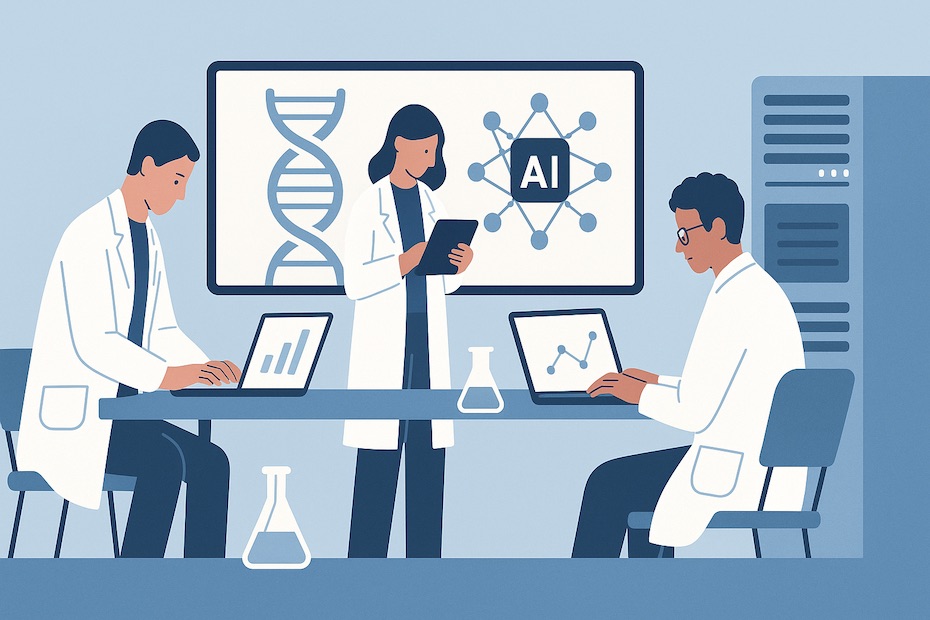
You can integrate AI and machine learning into your biotech R&D pipeline by preparing high-quality data, embedding predictive models in workflows, and validating results continuously.
This article gives you a detailed roadmap for making AI/ML a functional part of your research operations. You’ll learn how to build data foundations, select models, embed predictions into experiments, and scale these solutions effectively across your organization.
What Are the Roles of AI and ML in Biotech R&D?
AI and ML accelerate discovery by predicting molecular behavior, optimizing assays, and identifying promising drug candidates before wet-lab validation. They also enhance decision-making at every stage of R&D.
For instance, ML models can predict whether a compound is likely to bind to a target or fail in toxicity screens. This lets you reduce the number of unnecessary assays and concentrate resources where the probability of success is higher.
You gain both speed and cost efficiency. Instead of relying solely on brute-force screening, AI-driven prioritization sharpens your pipeline.
Build a Clean, AI-Ready Data Foundation
Data is the fuel that drives AI. If your lab data is inconsistent, incomplete, or fragmented, any model you deploy will underperform.
The first step is to unify datasets from assays, omics platforms, imaging, and metadata into a consistent schema. Implement ETL pipelines to remove duplicates, handle missing values, and normalize features. Standardizing identifiers for genes, proteins, and samples prevents errors during training.
A well-governed data layer also helps you maintain compliance and version control. Treat this layer as a core asset—it determines the quality of all downstream predictions.
Select the Right Machine Learning Models
Not all problems require deep learning. Choosing the right ML approach depends on your data type and use case.
For compound property prediction, regression models or graph neural networks are effective. For binary outcomes (e.g., active vs. inactive compound), gradient boosting or random forest classifiers often outperform more complex models on smaller datasets. Temporal assay data may call for recurrent networks or transformer models.
Balance accuracy with interpretability. In regulated biotech environments, explainable models often provide a stronger foundation than opaque black-box approaches.
Embed Predictions Directly into Workflows
AI delivers the most value when predictions guide real-time decisions, not when they sit unused in a report.
In drug screening, ML models can pre-rank compounds for wet-lab testing, ensuring you only run assays on the most promising candidates. In gene editing, predictive models can score guide RNA efficiency, preventing wasted experiments on low-performing targets. In imaging pipelines, ML can flag artifacts automatically, helping you avoid flawed downstream analysis.
Embedding predictions as decision gates shortens development cycles and reduces material waste.
Validate and Continuously Monitor Models
Model performance degrades if you don’t validate it on new data. A model trained today may drift tomorrow as assays evolve or batch effects shift.
Implement robust validation using cross-validation, independent test sets, and external benchmarking. Track metrics like ROC AUC, F1 score, or RMSE depending on your prediction type. More importantly, monitor performance longitudinally as new data arrives.
Set thresholds that trigger retraining or recalibration. Establishing this monitoring discipline ensures your models remain trustworthy decision-making tools.
Deploy at Scale with APIs and Containers
Moving from prototypes to production requires scalable deployment. Containerize your models with Docker or Singularity so they run consistently across environments. Expose them as APIs or microservices that integrate directly into your LIMS, ELN, or automation platforms.
Each input—whether a compound ID, sequence, or image—should trigger a model call that returns predictions instantly. Log every request and result to maintain traceability and compliance.
Deploying at scale transforms AI from a side experiment into a reliable part of daily R&D operations.
Leverage Transfer Learning and Pretrained Models
Training models from scratch is often impractical. Instead, you can adapt pretrained models developed on large public datasets.
Protein language models trained on UniProt sequences, for example, can be fine-tuned for your specific enzyme activity prediction task. Molecular property predictors built on millions of compounds can be adapted to your proprietary chemical libraries.
Transfer learning reduces the data requirements for training and accelerates model performance. This strategy helps smaller teams compete effectively with limited datasets.
Orchestrate AI Pipelines with Workflow Tools
Complex AI workflows include multiple steps: preprocessing, feature extraction, model inference, and reporting. Managing this manually is inefficient and error-prone.
Use orchestration frameworks like Nextflow, Snakemake, or Apache Airflow to structure these pipelines. They ensure reproducibility, handle errors gracefully, and allow you to swap in new components without rewriting entire workflows.
This orchestration makes AI adoption scalable across teams, enabling you to standardize best practices and maintain operational discipline.
Apply AI to High-Impact Use Cases
Certain use cases consistently deliver outsized value in biotech R&D:
- Target prioritization based on predictive ranking of genes or proteins.
- ADMET prediction to eliminate toxic candidates earlier in the pipeline.
- Assay triaging to identify failures before running costly experiments.
- Generative design for molecules or proteins with desired properties.
- Imaging augmentation for rapid cell phenotype detection or artifact removal.
Case studies show measurable improvements: one cross-drug response model (DeepCRE) improved predictive performance by 17.7% over baselines, demonstrating the competitive advantage of AI-enabled workflows.
How Do You Integrate AI into Biotech R&D?
- Unify and clean datasets
- Choose suitable models
- Embed predictions into workflows
- Validate continuously
- Deploy via APIs and containers
- Use transfer learning
- Automate pipelines with orchestration
In Conclusion
You integrate AI and machine learning into your biotech R&D pipeline by starting with clean data, choosing the right models, embedding predictions into daily workflows, and validating them continuously. With scalable deployment and smart orchestration, AI moves from a side project to a true engine of discovery.

Maurizio Chiriva Internati (DBSc, PhDs) is a cancer immunologist and biotech entrepreneur with 20+ years in immuno-oncology. Co-founder and former CEO of Kiromic BioPharma (NASDAQ: KRBP), he has led AI-driven target discovery and translational programs, and has served on faculty at MD Anderson and Texas Tech.