
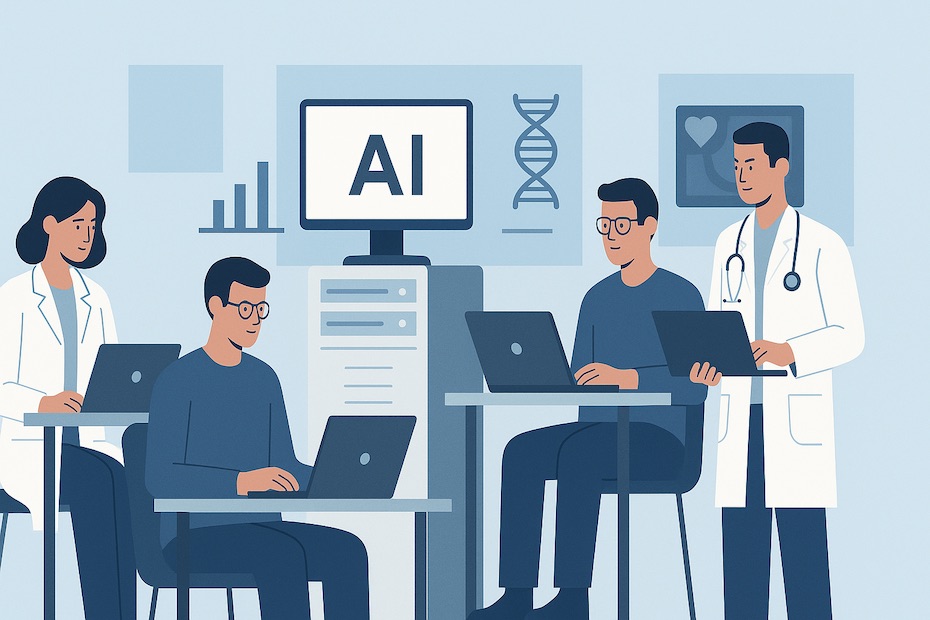
You can use AI tools to boost innovation in healthcare by applying them in diagnostics, operations, R&D, and clinical decision support, while embedding governance and scalability.
This article gives you a structured blueprint for selecting, deploying, and scaling AI solutions across healthcare. You’ll learn where AI is proving most valuable, how to integrate tools into workflows, and what governance steps ensure they deliver sustainable innovation.
What Types of AI Tools Are Transforming Healthcare?
AI tools in healthcare typically fall into four categories: diagnostics, clinical decision support, operations, and research. Each plays a different role in driving innovation.
Diagnostics tools analyze imaging, pathology slides, or sensor data at scale. Clinical decision support tools synthesize EHR and lab data to guide treatment plans. Operational AI agents automate documentation, scheduling, and resource allocation. Research-oriented AI models accelerate drug discovery and trial design.
Understanding these categories helps you map AI tools to your innovation objectives and identify which segment offers the fastest wins for your organization.
How Can AI Improve Diagnostics and Decision Support?
AI-powered diagnostics now serve as second readers in radiology, pathology, and cardiology. Tools like Aidoc detect life-threatening findings in CT scans faster than traditional workflows, enabling earlier interventions.
AI decision support integrates patient data, lab values, and imaging to generate predictive risk scores. These systems assist clinicians by highlighting patients at risk for sepsis, stroke, or heart failure.
When implemented, these tools don’t replace clinical judgment—they provide an additional layer of confidence, reduce diagnostic errors, and shorten time to treatment.
What Role Does AI Play in Automating Healthcare Operations?
Healthcare organizations spend significant resources on administrative tasks. AI automation reduces that burden, freeing clinicians to focus on patient care.
NLP-enabled tools can generate draft clinical notes from consultations, while AI scheduling platforms optimize appointment slots to reduce no-shows. Revenue cycle management also benefits, with ML models predicting coding errors or billing denials before they occur.
By automating these back-office tasks, you reduce operational costs, increase throughput, and reallocate talent to higher-value activities.
How Do You Apply AI in Drug Development and Biotech R&D?
AI accelerates R&D by predicting molecular properties, designing novel compounds, and optimizing trial protocols.
Molecular property prediction models can filter compound libraries, cutting down unnecessary wet-lab screening. Protein language models help predict target-drug interactions, while AI-driven patient recruitment ensures trials enroll candidates most likely to respond.
Embedding AI early in R&D reduces cycle times and lowers the financial risk of failed candidates, making your innovation pipeline more efficient.
What Challenges Do You Need to Manage?
AI integration comes with hurdles: bias, interpretability, integration complexity, and compliance.
Biased training data can lead to unequal outcomes across patient groups. Regulatory requirements demand transparent audit trails, meaning black-box models often require interpretability layers. Integrating AI tools with EHRs or imaging systems often exposes gaps in APIs and data governance.
To manage these risks, establish multidisciplinary teams with clinicians, engineers, and compliance experts. Strong governance ensures AI deployments remain safe and effective.
What Is the Right Deployment Roadmap?
Deploying AI in healthcare requires a phased approach:
- Identify a pilot use case with clear ROI potential
- Develop and validate models offline with historical data
- Run shadow deployments where AI outputs are visible but not used for decisions
- Transition to live integration once confidence is established
- Monitor continuously for drift and retrain as needed
This roadmap balances innovation with risk management, ensuring adoption grows sustainably and clinicians trust the system.
Which AI Platforms and Frameworks Should You Consider?
Selecting the right platform is crucial. MONAI provides an open-source foundation for medical imaging tasks. Platforms like MAIA enable cross-functional collaboration between clinicians and data scientists, simplifying deployment. OpenEvidence supports clinical decision-making by surfacing referenced answers.
You should choose platforms that integrate well with your IT infrastructure and align with your domain focus—whether imaging, EHR analysis, or research. Scalability and support are non-negotiable factors.
Benefits of Using AI Tools in Healthcare Innovation
The measurable benefits of AI deployment include:
- Faster, more accurate diagnostics
- Reduced administrative overhead
- Improved drug development efficiency
- Personalized treatment pathways
- Better predictive insights for population health
Delivering one successful AI use case often builds organizational momentum, leading to broader adoption and sustained innovation.
How to Use AI Tools in Healthcare
- Apply AI in diagnostics and imaging
- Automate documentation and operations
- Use AI in R&D and drug discovery
- Adopt healthcare-specific AI platforms
- Manage data, bias, and governance carefully
In Conclusion
You boost healthcare innovation with AI tools by targeting diagnostics, operations, research, and clinical support. The key is combining clean data pipelines, explainable models, and phased deployments with continuous monitoring. By aligning AI initiatives with real-world needs, you accelerate progress while maintaining trust and compliance.

Maurizio Chiriva Internati (DBSc, PhDs) is a cancer immunologist and biotech entrepreneur with 20+ years in immuno-oncology. Co-founder and former CEO of Kiromic BioPharma (NASDAQ: KRBP), he has led AI-driven target discovery and translational programs, and has served on faculty at MD Anderson and Texas Tech.