
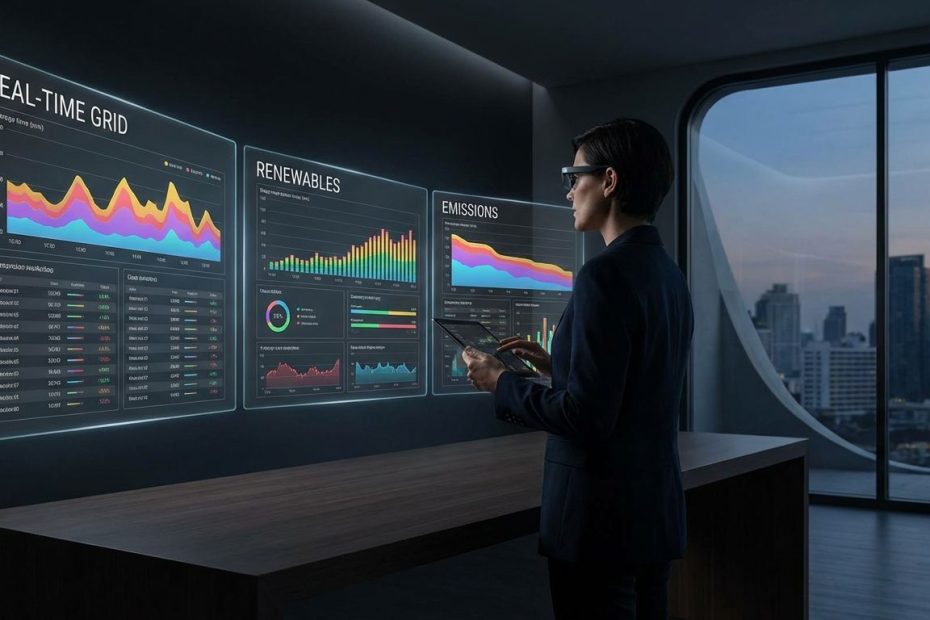
Technology is tackling sustainability by driving down the cost of clean electricity, tightening measurement of high-impact emissions like methane, electrifying buildings and transport, and forcing data centers and AI to operate within real grid limits.
You get results when sustainability tech is treated as an operating system: measure what matters, deploy what already wins on cost, and enforce accountability where emissions hide.
What Technologies Are Making The Biggest Real-World Impact On Sustainability Right Now?
If the goal is near-term emissions reduction at scale, the biggest impact still comes from clean power buildout paired with grid flexibility. Utility-scale solar and onshore wind keep winning on cost in many markets, and battery storage keeps improving as a grid tool. That combination matters because it replaces fossil generation directly, not through offsets or optimistic assumptions about behavior change.
IRENA reports that 91% of newly commissioned utility-scale renewables in 2024 delivered power cheaper than the cheapest new fossil alternative. It also points to massive avoided fossil fuel spending across the installed fleet, and it highlights battery storage cost declines since 2010, with utility-scale system costs cited around USD 192 per kWh in 2024. These numbers explain why sustainability progress often looks “boring” in practice: more interconnection, more substations, more transmission, more storage, faster permitting, tighter construction execution.
Outside the power sector, the fastest payback frequently comes from electrification and efficiency. Heat pumps, building envelope upgrades, industrial motors and drives, smarter controls, and demand response do not need perfect markets to work, they need competent installation and clear incentives. Methane monitoring and repair in oil and gas is another standout because it links detection to action in a way that can be verified, and because the warming impact of methane makes reductions show up quickly in climate outcomes.
Is AI Actually Helping Fight Climate Change, Or Is It Mostly Greenwashing?
AI helps when it does three things: improves measurement quality, cuts waste in an existing process, or raises throughput without raising energy per unit of work. Grid forecasting, predictive maintenance, industrial quality control, and methane plume detection are the practical wins. The trap is treating generative AI as a climate product without tying it to verifiable reductions and without accounting for the energy and water required to run it at scale.
A recent analysis reported by major outlets reviewed 154 climate-benefit claims connected to AI and found that many claims lacked solid evidence, and that none of the highlighted generative AI examples showed “material, verifiable, substantial” emissions reductions. A second reporting summary of the same analysis notes that only a minority of claims cited academic work, with a large share citing no evidence at all. If a climate claim cannot survive a procurement-style audit trail, it is marketing, not sustainability execution.
The credibility standard that works in practice is simple: require a baseline, a measured delta, and a boundary that prevents double-counting. Ask for energy use, water use, utilization changes, and the operational lever that produced the reduction. If the answer is “AI will enable innovation,” treat it as R&D, not a near-term abatement line item. This evaluation framework aligns with peer-reviewed research on verifiable sustainability metrics and performance accountability, which emphasizes measurable system boundaries and audited outcomes in climate technology deployment.
How Much Electricity Are Data Centers And AI Using, And Why Does It Matter For Sustainability?
Data centers have moved from “someone else’s problem” to a first-order grid planning variable. The IEA attributes around 180 TWh of electricity consumption in the United States to data centers in 2024 and expects continued growth through 2030, with a large incremental increase versus 2024 levels. That load growth collides with electrification of vehicles, buildings, and new industrial demand, so the local grid becomes the bottleneck even when the national generation picture looks manageable.
At the global level, an IEA-cited estimate used by the World Economic Forum places data center consumption around 415 TWh in 2024, with projections rising toward 945 TWh by 2030. You do not need to debate the exact number to act; the operational implication is the same: interconnection queues, transformer lead times, gas peaker reliance in constrained regions, and rising pressure on water and cooling systems.
Peer-reviewed and preprint research also shows why this matters beyond carbon totals. One U.S.-focused study compiling thousands of facilities estimated data centers accounted for more than 4% of total U.S. electricity consumption in the period studied, with a majority of supply coming from fossil sources, and it estimated more than 105 million tons of attributable CO2e. When carbon intensity is higher than the grid average, “average annual renewable matching” stops being a comfort blanket and starts looking like a risk.
Are Heat Pumps And Home Electrification Upgrades Actually Worth It For Normal People?
Most households do not buy decarbonization, they buy comfort, reliability, and predictable bills. Heat pumps deliver when the home’s thermal envelope and distribution system are addressed with the same seriousness as the equipment swap. If you ignore air sealing, duct losses, or radiator sizing, the equipment may still work, but the operating cost and comfort profile may disappoint, and that drives the “heat pump regret” stories that slow adoption.
Community threads show the pattern: people want a simple payback answer, then they discover it depends on electricity and gas prices, climate zone, installer competence, panel capacity, and incentive timing. The existence of do-it-yourself calculators shared widely in heat pump communities reflects a real market gap: many quotes still lack transparent load calculations, seasonal performance assumptions, and rate plan comparisons. When contractors do not present those inputs clearly, homeowners end up crowdsourcing the analysis.
The professional-grade guidance to give a homeowner is operational, not ideological. Get a load calculation, confirm cold-climate performance where required, validate ductwork or hydronics, align the install with a time-of-use rate plan if available, and budget for envelope work. Once that is done, the upgrade stops being a gamble and becomes a managed investment that also reduces onsite combustion and improves indoor air quality.
Are Solar Panels Still Worth It In 2026, Especially With Financing And Insurance Costs?
Solar can still pencil out, yet household economics are now heavily driven by the financing product and local policy, not panel efficiency. Interest rates, dealer fees, insurance riders, roof work, and utility rules for net metering determine whether monthly cash flow turns positive. A proposal that “saves money” on a spreadsheet can still fail a household budget test if the financing terms front-load cost.
At the system level, renewables remain cost-competitive in many markets, which is why deployment keeps scaling. IRENA’s cost work supports the core point that new renewable generation is often cheaper than new fossil alternatives, yet it also flags grid integration and financing as binding constraints. That is the real story: the technology cost curve is no longer the main barrier, execution and market design are.
The buyer-side advice that reduces regret is consistent. Demand an itemized quote, compare cash versus financed pricing, validate production assumptions against shading and roof orientation, and confirm what the utility will pay for exports under today’s tariff. If the economics only work under one fragile assumption, treat the purchase as high risk and rework the plan.
How Is Tech Tackling Methane Emissions, And What’s Actually Measurable?
Methane is one of the highest-leverage targets because reductions show climate benefit quickly and because the emissions are often fixable with mature equipment and maintenance practices. The IEA describes energy-related methane emissions staying high, underreporting being widespread, and measurement-based approaches showing higher values than inventories. That is why sensing has become central: if you cannot see it, you cannot manage it, and you cannot enforce it.
Monitoring capability has expanded rapidly. The IEA notes more than 25 satellites in orbit that can provide methane insights and highlights methane-focused satellites that became operational in 2024, including MethaneSAT and Tanager-1, with higher resolution and lower detection thresholds. It also discusses evidence that dispersed smaller sources matter, not only the “headline” super-emitters, which changes how operators should staff LDAR and maintenance programs.
Regulation is turning that measurement into action. The U.S. EPA Super Emitter Program defines super-emitter events at 100 kg per hour of methane or greater detected via remote methods, and it lays out a detect-and-notify process using certified third-party notifiers with EPA-approved technologies. Operators then have defined response obligations within a set timeframe after notification, which creates a workflow you can audit. That detect, verify, repair loop is what “measurable sustainability tech” looks like in practice.
Is Carbon Capture Or Direct Air Capture Viable, Or Is It A Scam To Keep Polluting?
Carbon capture is not one thing, and viability depends on where it sits in the system. Point-source capture can make sense for select industrial processes where CO2 is concentrated and alternatives are limited, yet it still needs reliable storage, strong monitoring, and clear liability. Direct air capture faces a harder physics and cost problem because CO2 is dilute in air, so energy and materials requirements are high, and economics are sensitive to power prices and capacity factors.
Recent reporting on DAC highlights the gap between marketing targets and current economics. One major developer cited slower-than-expected cost declines, with updated projected capture costs still far above early goals, and it pointed to total removal costs rising further once storage is included. It also reported low cumulative removal volumes relative to ambition, and it described the sector’s dependence on supportive policy and durable demand for high-integrity removals. Treat that as a signal to apply strict procurement rules: additionality, durability, measured net removal, and opportunity cost of clean power use.
Operationally, the safe way to position carbon capture and removals is as a constrained tool for residual emissions, not a license to delay abatement. If a plan uses removals to cover emissions that could be eliminated through electrification, efficiency, or clean power procurement, the plan is exposing itself to future cost spikes, reputational risk, and policy tightening.
What Sustainability Technologies Deliver The Fastest Verified Emissions Cuts?
- Utility-scale solar, wind, batteries
- Methane monitoring plus LDAR
- Heat pumps, building efficiency
- Data center efficiency plus clean hourly matching
Build Your Sustainability Tech Stack Around Measurement And Execution
You get durable sustainability results by focusing on deployment-grade technology, verified measurement, and grid-aware operations. Clean power and storage keep doing the heavy lifting on cost and scale, methane programs convert detection into repair, and electrification wins when installation quality matches the equipment spec. Data centers and AI need the same discipline as any heavy industrial load: transparency, efficiency engineering, and procurement that matches real-time clean supply, not just annual paper claims. Put capital where reductions are auditable, and treat anything else as experimentation with clear boundaries and stop conditions.
References
- International Renewable Energy Agency (IRENA), “91% of New Renewable Projects Now Cheaper Than Fossil Fuels Alternatives” and report materials on renewable generation costs and storage costs. ([irena.org](https://www.irena.org/News/pressreleases/2025/Jul/91-Percent-of-New-Renewable-Projects-Now-Cheaper-Than-Fossil-Fuels-Alternatives))
- International Energy Agency (IEA), “Electricity Mid-Year Update 2025: Demand, global electricity use to grow strongly in 2025 and 2026” (data center electricity use in the United States and projections). ([iea.org](https://www.iea.org/reports/electricity-mid-year-update-2025/demand-global-electricity-use-to-grow-strongly-in-2025-and-2026))
- World Economic Forum, “How data centres can avoid doubling their energy use by 2030” (IEA-cited global data center electricity use and projections). ([weforum.org](https://www.weforum.org/stories/2025/12/data-centres-and-energy-demand/))
- IEA, “Global Methane Tracker 2025: Key findings” (satellite monitoring, underreporting, and mitigation observations). ([iea.org](https://www.iea.org/reports/global-methane-tracker-2025/key-findings))
- US EPA, “Frequently Asked Questions: Super Emitter Program” and “Methane Super Emitter Program: Certified Third-Party Notifiers” (definitions, thresholds, process). ([epa.gov](https://www.epa.gov/controlling-air-pollution-oil-and-natural-gas-operations/frequently-asked-questions-super-emitter))
- Guidi et al., “Environmental Burden of United States Data Centers in the Artificial Intelligence Era” (arXiv:2411.09786). ([arxiv.org](https://arxiv.org/abs/2411.09786))
- The Guardian, “Claims that AI can help fix climate dismissed as greenwashing” (summary of report reviewing AI climate claims). ([theguardian.com](https://www.theguardian.com/technology/2026/feb/17/tech-companies-traditional-ai-generative-climate-breakdown-report))
- Euronews, “AI greenwashing: Most of Big Tech’s AI climate promises fall flat, study finds” (additional reporting on the same analysis). ([euronews.com](https://www.euronews.com/next/2026/02/17/ai-greenwashing-most-of-big-techs-ai-climate-promises-fall-flat-study-finds))
- Financial Times, “Direct carbon capture falters as developers’ costs fail to budge” (DAC cost and scaling headwinds). ([ft.com](https://www.ft.com/content/fa4ce69b-e925-4324-a027-cdf86e66163f))

Maurizio Chiriva Internati (DBSc, PhDs) is a cancer immunologist and biotech entrepreneur with 20+ years in immuno-oncology. Co-founder and former CEO of Kiromic BioPharma (NASDAQ: KRBP), he has led AI-driven target discovery and translational programs, and has served on faculty at MD Anderson and Texas Tech.