
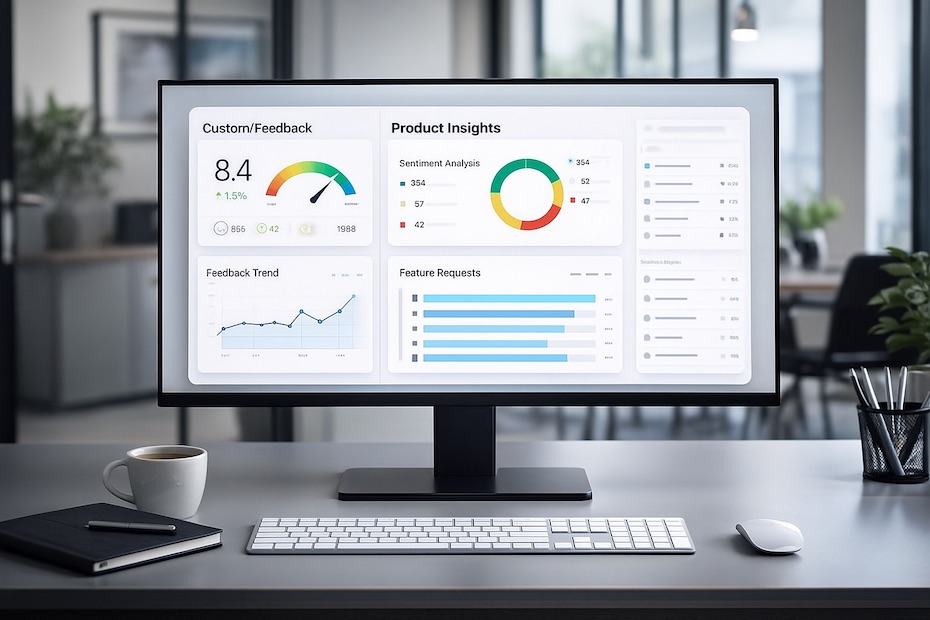
You drive product innovation by using customer feedback tools that turn real user signals into clear, actionable direction. You move faster when your insights come from structured platforms instead of disconnected comments or guesswork.
This article gives you a focused breakdown of the five strongest feedback tools used by product teams that want measurable learning cycles. You’ll see how each platform strengthens voice-of-customer intelligence, shortens development loops, and helps you build solutions people value.
1. Qualtrics
Qualtrics gives you an enterprise-level system for collecting, analyzing, and operationalizing customer feedback. You use it when you need structured, reliable data at scale.
The platform helps you build targeted surveys, track sentiment, and connect qualitative feedback with quantitative scoring. Its analytics engine helps you identify patterns, evaluate priorities, and monitor customer expectations across multiple touchpoints. You gain a more complete picture because the system consolidates diverse inputs into a single view.
Teams in SaaS, retail, healthcare, and financial services rely on Qualtrics when accuracy and depth matter. You strengthen product decision-making when your insights come from well-governed, high-quality data.
2. UserTesting
UserTesting gives you direct access to real human behavior through moderated and unmoderated user sessions. You use it when you want to watch customers interact with your product or prototype in real time.
The platform helps you evaluate usability issues before they surface at scale. You can test onboarding flows, identify friction points, and capture real customer reactions. These live interactions help you refine features, improve clarity, and reduce the guesswork that often delays product improvements.
UserTesting works well for product design teams, UX researchers, and growth groups building features that rely on seamless user experience. When you make decisions based on real behavior instead of speculation, your product becomes more intuitive and more competitive.
3. Hotjar
Hotjar gives you visual feedback that helps you understand how customers navigate your product interface. You use it when you want clarity on user patterns, not just written opinions.
Heatmaps show you where users click, scroll, or ignore elements on your page. Session recordings help you identify where frustration slows progress. Hotjar’s feedback widgets also give users a quick way to share opinions in the moment instead of waiting for long-form surveys.
The platform works especially well when you want to validate UI improvements quickly. You reduce rework because each adjustment is supported by real usage patterns, not assumptions. This speeds up experimentation and strengthens the quality of your product decisions.
4. Intercom Surveys & Messenger
Intercom combines customer communication with built-in feedback tools that capture insights inside the user experience. You use it when you want to gather feedback without breaking customer flow.
Intercom helps you run micro-surveys, gather NPS data, and collect qualitative comments in real time. Because users respond inside the product, participation rates stay high. The platform also stores historical conversations, giving you an ongoing record of customer expectations, problems, and requests.
Teams use Intercom to accelerate product iteration because the feedback comes from active users at meaningful touchpoints. You gain a clearer sense of what customers value and where improvements matter most.
5. Productboard
Productboard turns customer insights into structured product direction. You use it when you need a centralized system that links feedback to roadmaps and development priorities.
The platform organizes customer comments, feature requests, and team notes into actionable buckets. You can score ideas based on customer impact, effort, or strategic fit. Productboard helps you make informed decisions because feedback isn’t scattered across spreadsheets or chat threads.
This tool supports product managers who want a disciplined approach to roadmap planning. When you align customer signals with development resources, you increase the likelihood that each feature delivers measurable value.
How do you choose the right customer feedback tool?
You choose the right tool by matching your product maturity, feedback volume, and insight needs to a platform’s core strength.
You start by identifying your primary use case. If you want behavior tracking, a tool like Hotjar fits. If you want strategic, data-driven voice-of-customer systems, Qualtrics delivers better scale. If you want rapid insights from real user behavior, UserTesting performs well. This matching process prevents you from overbuying or misaligning your workflows.
You also evaluate integrations. Strong tools connect easily to your analytics stack, CRM, development solutions, and data warehouse. Alignment helps you build consistent insight loops instead of disconnected information silos. You gain speed and precision when your systems reinforce each other.
Which feedback methods produce the most reliable insights?
The most reliable feedback comes from mixed methods that combine behavior, sentiment, and direct user observation.
Behavioral data tells you what customers do, which reduces reliance on self-reported interpretation. Sentiment surveys give you emotional signals that explain motivation. Direct observation through video sessions reveals friction you cannot see in raw numbers. When you combine these three categories, you gain a more complete picture.
Reliable insights also come from structured processes. You strengthen reliability when your questions are clear, your sample is meaningful, and your timing matches the user’s actual experience. This increases accuracy and supports better product decisions.
Best Customer Feedback Tools for Product Innovation
- Qualtrics
- UserTesting
- Hotjar
- Intercom
- Productboard
Build Products That Win Through Constant Learning
You increase product innovation when your decisions are grounded in real user signals instead of instinct or preference. The tools in this guide help you capture the voice of your customer, spot friction early, and refine your roadmap with confidence. When you build habits around structured feedback, you strengthen your execution and reduce wasted cycles. Commit to gathering the right insights consistently and you’ll accelerate your product growth with greater clarity and precision.

Maurizio Chiriva Internati (DBSc, PhDs) is a cancer immunologist and biotech entrepreneur with 20+ years in immuno-oncology. Co-founder and former CEO of Kiromic BioPharma (NASDAQ: KRBP), he has led AI-driven target discovery and translational programs, and has served on faculty at MD Anderson and Texas Tech.