
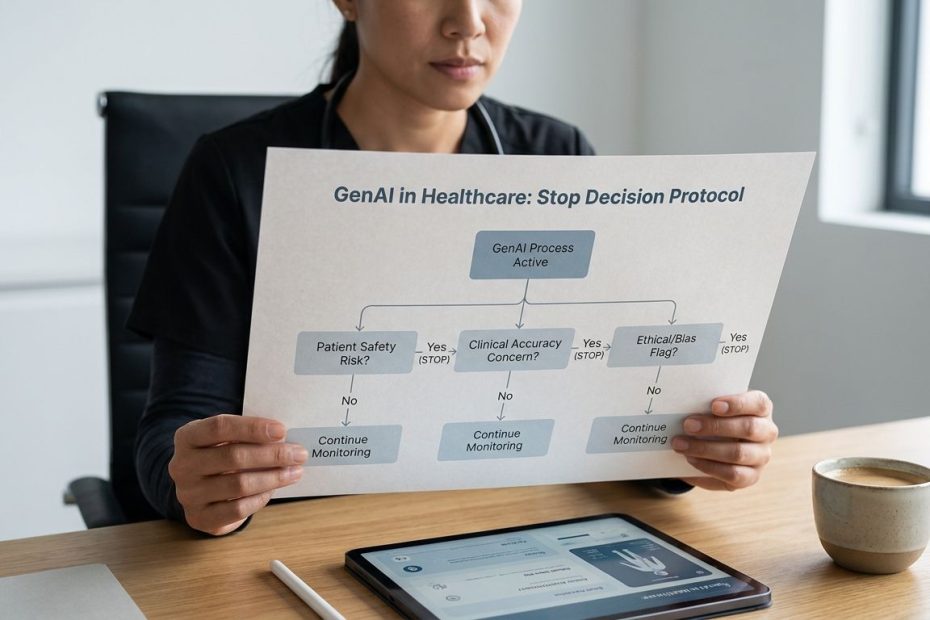
Generative artificial intelligence can support work around care, but you should not use it when it can change diagnosis, triage, treatment, patient behavior, or privacy risk without strong controls. The fastest way to stay safe is to treat GenAI as a restricted tool, not a default assistant, and block its use the moment a case crosses into clinical judgment, protected data, or patient-facing advice.
You are about to make better decisions much faster if you use a simple stop-based filter before anyone opens a prompt box. This article gives you that filter in plain language, shows where organizations get into trouble, and helps you separate low-risk drafting from care decisions that demand validated systems, clinician review, and formal governance.
What Does “Do Not Use GenAI In Care” Actually Mean?
When you say “do not use GenAI in care,” you are not saying artificial intelligence has no place in healthcare. You are saying a general-purpose model should not be allowed to influence care when the output could alter diagnosis, urgency, medication use, discharge behavior, or any other decision that affects patient safety. That distinction matters because many teams blur the line between support work and clinical work, then discover too late that the model’s output carried more weight than intended.
You need a practical rule: if the model’s words can move a clinician or patient toward action, you are no longer in a harmless drafting exercise. You are in a risk-bearing workflow. At that point, the burden shifts from “Is this convenient?” to “Is this validated, governed, reviewable, secure, and safe enough for this exact use case?” If you cannot answer yes across those points, the correct decision is to stop.
This is where many care organizations lose discipline. A tool starts as a note helper, then gets used to summarize symptoms, then to suggest next steps, then to draft patient advice. The user experience feels smooth at every step, which is why the control failure is so common. Your decision tree has to interrupt that slide early, before convenience turns into unapproved clinical influence.
Should You Use GenAI For Diagnosis, Triage, Or Treatment Decisions?
No. If the output will directly shape diagnosis, triage, treatment selection, or urgency of care, you should not use a general-purpose GenAI tool. This is the cleanest stop point in the decision tree, and it needs no soft wording. The model may sound polished, organized, and clinically aware, yet still produce wrong answers, omit critical factors, or present uncertainty as confidence.
You do not need a dramatic failure to create harm. A slightly wrong summary of symptoms can shift the likely diagnosis. A calm-sounding triage answer can delay needed escalation. A medication suggestion framed as plausible can anchor a busy clinician’s thinking. In care delivery, small deviations matter because they stack quickly across time pressure, incomplete records, and human trust in fluent output.
Industry guidance has been moving in one direction on this point: human oversight is essential, and hallucination risk is real. Research coverage has also highlighted weak diagnostic performance from large language models in medical challenge settings. You should read that as a warning sign, not a minor limitation. If a model is not a validated clinical system built for a defined intended use, keep it out of diagnosis, triage, and treatment decisions.
Your operational rule should be blunt: if today’s output can change what care is given, when care is given, or whether care is sought, do not use general-purpose GenAI. Route the case to approved clinical tools and qualified clinicians. That one rule removes a large share of the unsafe ambiguity teams create for themselves.
Should You Paste Patient Notes, Images, Or Identifiable Data Into A Public GenAI Tool?
No. If the tool is public, consumer-grade, or not explicitly approved inside your organization’s secure environment, do not enter protected health information, identifiable patient details, clinical images, or copied chart text. This is another hard stop. Privacy risk is not limited to external breach headlines. It includes retention, secondary use, incomplete deletion, uncertain access controls, weak logging, and unclear contractual boundaries.
You also need to watch for the false comfort of partial de-identification. Staff often remove a name and assume the problem is solved, yet the remaining details may still identify a patient when combined with age, dates, location, condition, or unusual history. In a care setting, “probably anonymous” is not a control. If your organization has not approved the exact workflow and the exact tool for sensitive data handling, you should assume the answer is no.
This is where informal use becomes dangerous fast. A clinician wants help rewriting a note, summarizing a consult, or cleaning up discharge instructions, copies text into a public chatbot, then moves on. That one shortcut may violate policy, create reportable exposure, or put the organization in a position where it cannot explain where the data went, who could access it, or how it may be reused. You do not want privacy decisions being made by individual convenience.
Your decision tree should force an early gate: will any patient-identifiable information enter the tool? If yes, stop unless the platform is approved, contracted, access-controlled, monitored, and authorized for that use. If the answer is uncertain, treat uncertainty as no. In care operations, ambiguous data handling is a risk signal, not a green light.
When Does Hallucination Risk Make GenAI A Bad Fit?
You should avoid GenAI whenever a wrong answer will sound believable and the user cannot quickly verify every meaningful claim before acting. That is the practical test. Hallucination is not just fabricated facts. It also includes confident omission, invented citations, distorted summaries, wrong prioritization, and advice that sounds measured while missing the patient-specific detail that changes the case.
The danger grows when the task feels routine. Busy users are less likely to challenge fluent output when it matches the shape of what they expected. That is why hallucination risk is not solved by saying “a human is in the loop.” Human review only works when the reviewer has time, expertise, source access, and a reason to distrust the model. If your workflow does not create those conditions, the review step is cosmetic.
You should ask a hard question before any GenAI use in care operations: can a qualified clinician verify every critical statement before anyone acts on it? If the answer is no, the use case is a poor fit. Symptom interpretation, medication instructions, patient messaging, escalation decisions, and diagnostic summaries often fail this test because the review burden is too high or the false confidence risk is too easy to miss.
That is why your decision tree needs a verification checkpoint before deployment, not after an incident. If the content can be safely checked line by line against trusted sources and patient records, you may be in limited drafting territory. If it cannot, you should block the use. Trust should follow validation, not smooth prose.
Should You Use GenAI For Patient Messages, Discharge Instructions, Or Symptom Advice?
Not unless the workflow is tightly controlled, the tool is approved, and a qualified clinician reviews the output before it reaches the patient. Patient-facing communication looks simple on the surface, yet it sits close to behavior change. A short message can influence whether a patient seeks urgent care, starts or stops a medication, ignores a warning sign, or misunderstands a follow-up plan.
You should treat patient-facing output as high-risk content unless proven otherwise. A model may use the right tone and still miss the one caution that matters. It may compress instructions in a way that removes needed detail. It may personalize language in a way that sounds reassuring when the safer message was escalation. In care, style does not reduce liability. It can increase it when it makes unsafe advice easier to accept.
This matters even more in discharge and after-visit communication. Patients read those materials without a clinician standing beside them. They may be tired, worried, distracted, or dealing with limited health literacy. If GenAI introduces one wrong instruction or leaves out one red-flag symptom, the patient carries the consequence home. That is why direct-to-patient medical guidance should not be treated as ordinary content generation.
Your decision tree should ask: will this output go directly to a patient, family member, or caregiver, and could it alter care-seeking or medication behavior? If yes, stop unless you have an approved workflow with clinician review, monitoring, and documented accountability. If no one owns the final safety check, no one owns the risk.
When Does GenAI Cross Into A Regulated Medical Device Function?
You need to stop and escalate the moment the tool starts behaving like software that predicts, diagnoses, prioritizes, or recommends clinical action. At that point, you are no longer talking about a casual writing helper. You are dealing with a function that may fall into medical device territory, quality system expectations, and formal regulatory scrutiny depending on intended use and implementation.
This is where many teams misuse language to avoid discipline. They call it a “copilot,” “assistant,” or “productivity layer,” yet the tool is ranking patient risk, suggesting treatment pathways, flagging instability, or steering decisions inside the workflow. Renaming the function does not change the function. If the system influences diagnosis or treatment in a material way, you need validation, change control, traceability, and a formal governance path.
You also need to pay attention to model updates. A generative system can drift in behavior after tuning, vendor changes, prompt changes, retrieval changes, or surrounding workflow changes. If your use case affects care decisions, uncontrolled change becomes a safety issue. That is why quality and regulatory teams care about intended use, test evidence, monitoring, and documented update processes. A model that changes quietly is not suitable for silent insertion into clinical care.
Your decision tree should include a direct branch: does this function predict, diagnose, prioritize, or recommend action related to care? If yes, route it out of casual use and into regulatory, quality, and clinical governance review. Until that pathway is complete, do not deploy it in care. Convenience does not exempt a system from its real function.
When Should Governance Fail The Use Case Before Anyone Tests It?
You should stop before pilot work begins if there is no policy owner, no risk review, no privacy review, no incident reporting path, no monitoring plan, and no named accountable leader. Governance is often treated like a later-stage formality, yet in healthcare it is the filter that prevents unsafe pilots from entering live workflows. If the organization cannot state who approved the use, what controls apply, and how failures will be caught, the use case is not ready.
This is where executives and clinical leaders need discipline. Teams often want to “start small” with a limited rollout and learn as they go. That may be acceptable in low-risk administrative settings, but it is not acceptable when patient data, clinical reasoning, or patient-facing communication is involved. Learning in production is a poor strategy when the failure modes are hidden, uneven, and hard to detect until harm is already moving through the system.
You also need governance that matches operational reality, not policy theater. A one-page approval note does not help if frontline users can still bypass controls, if prompts are copied into unapproved tools, if outputs are not logged, or if no one reviews errors. Governance needs to define approved use cases, prohibited use cases, escalation rules, audit rights, and consequences for misuse. Anything less leaves the burden on individual judgment under time pressure.
Your decision tree should start with governance, not end with it. If the organization lacks basic controls for ownership, review, monitoring, and reporting, the right answer is no use in care workflows. You can always reopen the case when the controls exist. You cannot undo a weak launch once staff behavior spreads faster than policy.
What Is The Simple Decision Tree You Can Use Right Now?
You do not need a complicated model inventory to make better decisions today. You need a front-loaded stop tree that shuts down unsafe use early. If any answer below is yes, you should stop and route the work away from general-purpose GenAI unless the organization has an approved, validated, monitored solution for that exact purpose.
Start with the first gate: is the tool being used for diagnosis, triage, treatment selection, urgency decisions, medication guidance, or any other action that can change care? If yes, do not use general-purpose GenAI. Move to the second gate: will you enter protected or identifiable patient data, images, notes, or copied chart content? If yes, do not use unless the environment is explicitly approved for that data and that workflow.
Then ask the third gate: will the output go directly to a patient, caregiver, or family member? If yes, stop unless a qualified clinician reviews the exact content before release and the workflow is approved and monitored. The fourth gate is verification: can a qualified reviewer reliably check every material claim before anyone acts on it? If no, the use case fails. The fifth gate is function: does this system predict, diagnose, prioritize, or recommend clinical action? If yes, route it to formal clinical, quality, privacy, and regulatory review before any deployment.
If the use case passes all those gates, you may still restrict it to lower-risk support work. That usually means formatting, grammar cleanup, template drafting without patient data, meeting summarization in approved environments, plain-language rewriting after expert review, or internal administrative drafting that does not influence care decisions. Passing the tree does not make the tool safe for anything. It only means the proposed use has not triggered an obvious stop point.
Where Can You Safely Draw The Line Between Care Use And Administrative Use?
You should draw the line based on consequence, not job title. A task is not low-risk just because it happens outside the exam room. Scheduling language can still affect follow-up compliance. Referral summaries can still distort urgency. Benefit explanations can still confuse patients about what action to take. The right question is whether the output can change patient care, patient behavior, or protected data exposure.
Administrative use becomes more acceptable when the content does not require clinical judgment, does not include patient-identifiable information, and can be reviewed easily for accuracy before use. Internal brainstorming, nonclinical email drafting, policy style cleanup, generic staff education wording, and blank-template editing often fit this category when handled inside approved tools. Even there, you still need policy, logging, and user training because low-risk misuse can spread into higher-risk behavior fast.
You also need to prevent function creep. Teams often approve GenAI for scheduling scripts or generic communications, then staff begin pasting real patient situations into prompts because the tool “worked well last time.” That drift is predictable. Your controls should state what the tool is approved for, what data is prohibited, what review is required, and when a task must be escalated to a clinician or compliance lead.
The safer line is simple: if the task can stand on its own without clinical interpretation, patient-specific facts, or advice that changes action, it may qualify for restricted administrative use. The moment it touches patient-specific judgment, medical guidance, or protected information without an approved environment, you stop. That line keeps the tool in support work instead of letting it seep into care delivery.
When Should You Not Use GenAI In Care?
- Do not use GenAI for diagnosis, triage, treatment, or urgent symptom advice.
- Do not paste protected patient data into unapproved tools.
- Do not send patient-facing medical guidance without clinician review.
- Do not deploy it when errors cannot be verified fast.
Use The Stop Signals Before The Prompt Box
You will make stronger decisions with GenAI in healthcare when you block unsafe uses early instead of trying to fix them after rollout. The pattern is consistent: if the tool can alter care, expose patient data, or send unverified guidance to patients, it does not belong in casual use. Your decision tree should stay simple enough for frontline staff to apply in seconds and strict enough to stop the most common mistakes without debate. Keep the model in controlled support roles, route anything that touches clinical action into formal review, and require approved environments for any patient-related data. If you enforce those stop signals before anyone types a prompt, you protect patients, clinicians, and the organization at the same time.

Maurizio Chiriva Internati (DBSc, PhDs) is a cancer immunologist and biotech entrepreneur with 20+ years in immuno-oncology. Co-founder and former CEO of Kiromic BioPharma (NASDAQ: KRBP), he has led AI-driven target discovery and translational programs, and has served on faculty at MD Anderson and Texas Tech.